
Engagement Rings / Diamond Shapes
Marquise Engagement Rings: Guide to the Marquise Cut Diamond
Published October 8, 2026
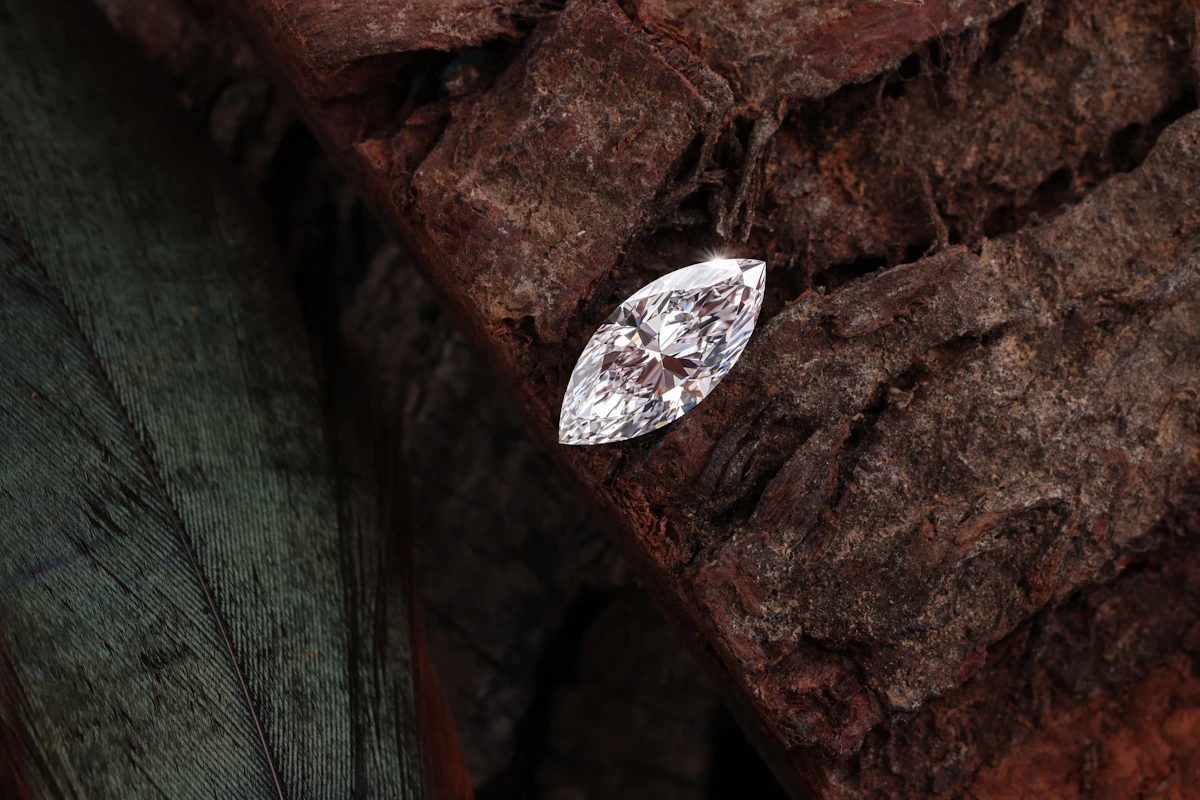
The marquise cut is long, pointed at both ends and impossible to ignore. Marquise engagement rings have a vintage soul and a modern edge, and because of their shape they offer one of the largest-looking faces of any diamond for the carat weight.
This guide covers how the marquise cut works, the proportions to look for, the settings that protect its delicate points and how it compares with other elongated shapes. For a side-by-side overview of every cut, read our guide to engagement ring shapes.
What is a marquise cut diamond?
A marquise (pronounced "mar-KEEZ") diamond is an elongated brilliant cut with curved sides and two pointed tips, often described as a football or boat shape. It usually has around 56 to 58 facets. According to popular legend, the shape was inspired by the smile of the Marquise de Pompadour in 18th-century France, which is how it got its name.
Pros and cons
| Pros | Cons |
|---|---|
| Very large face-up appearance for its carat weight | Pointed tips can chip without protective prongs |
| Strongly elongates the finger | Often shows a noticeable bow-tie |
| Distinctive, vintage-inspired look | Symmetry varies a lot between stones |
| Usually lower price per carat than a round | Fewer ready-made settings than round or oval |
Ideal marquise length-to-width ratio
Most marquise diamonds fall between 1.75 and 2.25. Around 2.0 is considered a classic balance. Lower ratios look wider and softer, while higher ratios look long and slender.
Symmetry matters more than usual
Draw an imaginary line down the middle of the stone: both halves should mirror each other, and the two tips should line up. Uneven "wings" or a tilted point are easy to notice in a marquise. Look for very good or excellent symmetry on the grading report and confirm it visually.
The bow-tie effect
Like ovals and pears, marquise diamonds often show a darker bow-tie across the middle. A light, crisp bow-tie adds contrast; a heavy, dark one makes the diamond look dull. Compare videos before choosing.
Clarity and color
- Clarity: brilliant faceting hides small inclusions, so SI1 to VS2 stones can be eye-clean. Avoid inclusions near the tips, where they can weaken the stone.
- Color: color can concentrate at the points. G to H is a popular choice for white metals; I to J often looks fine in yellow gold.
Best settings for marquise engagement rings
- Six-prong solitaire with V-prongs at the tips: the classic choice that protects both points. See solitaire engagement rings.
- Bezel or half-bezel: the most protective option for active lifestyles. Read bezel engagement rings.
- East-west: set horizontally for a striking modern look.
- Three stone or cluster: pair with round or pear side stones for a vintage style. See three stone engagement rings.
- Halo: adds sparkle and size. See halo engagement rings.
Marquise vs oval vs pear
| Shape | Ends | Typical ratio | Style |
|---|---|---|---|
| Marquise | Two points | 1.75 to 2.25 | Bold, vintage |
| Oval | Two rounded ends | 1.30 to 1.50 | Soft, classic |
| Pear | One point, one round end | 1.45 to 1.75 | Romantic teardrop |
Compare in depth with oval engagement rings and pear shaped engagement rings.
Buying tips
- Check symmetry first, then bow-tie, then clarity and color.
- Insist on V-prongs or a bezel at both tips.
- Consider a slightly smaller carat weight; the marquise already looks big.
- Get an independent grading report.
- Plan your budget with how much to spend on an engagement ring.
Frequently asked questions
Are marquise diamonds more fragile?
Their pointed tips are more exposed to knocks, so they can chip if left unprotected. V-prongs or a bezel setting greatly reduce this risk.
Do marquise diamonds look bigger?
Yes. The marquise has one of the largest face-up areas of any diamond shape for its carat weight.
Are marquise engagement rings in style?
Marquise rings have seen a strong revival, especially in vintage-inspired, east-west and yellow gold designs.
What is the best ratio for a marquise diamond?
Around 2.0 is classic, but anything between 1.75 and 2.25 can look beautiful depending on your preference.
Engagement Photo Guide Team
Editorial Team
The Engagement Photo Guide team writes practical guides on engagement rings, proposal ideas and engagement photos to help couples plan every step with confidence.